Tuesday, May 22, 2012

AA2G Serum

AA2G Serum:  AA2G is the stable C form which allows for a great deal of flexibility when formulating. It is proven in clinical trials to be effective antioxidant as well as up regulate collagen production.  Proline is included as it has been shown to be an effective quencher of photoexcited states ( QPES.)  L carnosine, is the most effective anti glycation active. The serum is elegant, light and silky. Ideal for day time wear under a sunscreen.

If you wish to simply purchase the AA2G serum, please contact MyFawnie
SkinCare forum is available to ask and answer questions. SEA has been invited to participate at that venue.


Ingredients Percentage
AA2G 2 %
Alpha Lipoic Acid 1%
Oil of preference 10 %
L-Proline 1%
L- Carnosine 1 %
Sclerotium gum 2 %
Vitamin E oil or acetate 1 %
Glycerin 2 %
Distilled water 76 %
Ferulic acid 0.5 %
1N NaOH 2 %
Phenoxyethanol 0.5 %
Adjustments 1 %


         pH 5.5

        1. AA2G into solution
        2. Ferulic acid into solution using 1N NaOH add to AA2G adjust pH to @ 5.5
        3. Proline, Carnosine, Vit E acetate. Blend.
        4. Sclerotium gum, blend. Will thicken.
        5.While blending slowly add ALA to oil at room temp.
        6.Combine oil and water phase + phenoxy.
        7. Leave over night, next day will be a thick gel and spreads like silk.

    *n.b. AA2G  is very acidic in solution. Adding small amounts of solid NaOH into the solution and testing is more effective,.mix a 3 to 4 N NaOH solution.

    AA2G- Ascorbyl Glucoside

    AA2G is the stable C form which allows for a great deal of flexibility when formulating. It is proven in clinical trials to be effective antioxidant as well as up regulate collagen production.

    L-Ascorbic acid functions in many biological processes i.e. anti-oxidation, collagen synthesis, intestinal absorption of iron and amino acid metabolization . L-ascorbic acid is essential as a cofactor for the hydroxylation of proline and lysine residues in collagen, a major protein component of the body. LAA also increases transcription rate of procollagen genes and stabilizes procollagen mRNA. AA2G has proven to be effective at percentages as low as 2% . It is the extremely stable form of vitamin C LAA is unstable and prone to oxidation in solution and only functional at pH below 3.5. AA2G is not limited by these requirements while delivering the same postive results as LAA. AA2G is stable to air, heat , light and metal ions. It's range of formulation is greater than MAP and delivers greater dermal benefits than any other C derivative at present. It is convenient to formulate with.


    The hydroxyl group of the second carbon in ascorbic acid is highly reactive and plays an important role in the natural biologic activity, however, it can also be the site of inactivation and decomposition.

    Ascorbyl Glucoside is produced from vitamin C and starch by using a natural enzymes which result in binding glucose to the hydroxyl group of the same reactive carbon of the ascorbic acid.


    An enzyme releases vitamin C at the cellular surface and provides benefits over a sustained period of time. Ascorbyl Glucoside is hydrolyzed by glucosidase, an enzyme present in the membrane of skin cells.

    This process releases vitamin C in its natural active form. When vitamin C enters cells it results in significant well-documented biological responses.

    Ascorbyl Glucoside has been demonstrated to be hydrolyzed over a prolonged period giving its beneficial physiological effects to the cells and tissues in a constant and sustained manner.

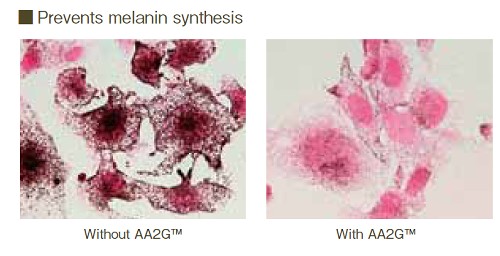
    Suppression of melanin synthesis:

    When Ascorbyl Glucoside is converted to vitamin C and enters the cells it significantly reduces the production of melanin by inhibiting tyrosinase activity. This results in a reduction of Dopaquinone, an intermediate of melanin synthesis. Additionally it converts existing Dopaquinone to L-Dopa.


    Ascorbyl Glucoside bleaching of extant melanin:

    When Ascorbyl Glucoside is converted to vitamin C and enters the cells it can significantly lighten existing black melanin by a reduction reaction.


    Reduction in  hyperpigmentation via AA2G topical application:
    Creams containing Ascorbyl Glucoside are beneficial for lightening skin pigmentation.

    Sixteen female volunteers (37 to 55 years old) applied a face cream containing 2% of AA2G™ twice a day to a hyperpigmented area of their face for a total of 90 days.The areas were matched against pantone color samples and the brightness (L* value) of the areas were measured by a colorimeter on day 0, 45 and 90. (*Significantly different from day 0 at <0.01)


     Ascorbyl Glucoside suppresses cellular damage due to UV irradiation:
    When Ascorbyl Glucoside is converted to vitamin C it can dramatically reduce the free radicals that result from UV irradiation of the skin, and significantly reduce cell damage. Human skin fibroblasts were cultured for 1 day. Fibroblast samples were cultured a second day with or without 1mM AA2G™. The cells were irradiated with 20mJ/cm2 UVA and B radiation, and then cultured for 2 additional days.
    The number of viable cells were determined. (*Significantly different from UV irradiated cells without AA2G™ at <0.05)


    Ascorbyl Glucoside promotes collagen synthesis:

    Collagen  plays an important role in the structure and firmness of skin.  Ascorbyl Glucoside is converted to vitamin C and  promotes collagen synthesis of skin fibroblasts. Ascorbyl Glucoside maintains its effects for a sustained period of time, resulting in increasing benefits.


    After cultivation of normal human skin fibroblasts for 1 day, the cells were cultured in the presence of vitamin C  0.2mM) or AA2G™ (0.2mM) for 2-4 days. The percentage of collagen to total protein was determined. (*Significantly  different from control at p<0.05, and significantly different from vitamin C at  p<0.05).


    Ascorbyl Glucoside reduces wrinkles and roughness:
    Products containing Ascorbyl Glucoside are highly beneficial for improving wrinkles and roughness of skin. Sixteen female volunteers (37 to 55 years old) applied a face cream containing 2% of AA2G™ twice a day for a total of 90 days to the outer corners of their eyes and cheek area. Silicone replicas of the corner of the eyes and the other treated areas were taken on days 0, 45 and 90 and wrinkle depth and skin roughness were measured by profilometry. (*Significantly different from day 0 at p<0.01)


    Saturday, January 14, 2012

    Solubility Chart

    Solubility chart.xlsx
    The following chart contains the most useful solvents for each active. If you click on the active name, it will redirect you to the optimal pH range for formulating as well as % usage.

    *n.b. Use the least amount of solvent possible to get the active into solution. Account for its weight as part of the oil or water phase respectively and make the appropriate adjustments to your formula/ recipe in the batch size calculator.

    1 N NaOH = 0.39 grams NaOH dissolved in 10 grams distilled water. Use the least amount necessary.


    Active Ingredient Solvent #1 Solvent #2 pH

    AA2G Water N/A 2.0-7.0

    Alpha Lipoic Acid Oil N/A 4.5-6.5

    L-Carnosine Water N/A 4.0~6.0

    Chrysin 1 N NaOH N/A 6.5-7.0

    Co Enzyme Q 10 Oil Ethanol 3.0-7.0

    Coffeeberry extract Water Ethanol 4.5-6.0

    D- Panthenol Water N/A 4.0-6.0

    Ellagic Acid 1 N NaOH N/A 6.8-7.2

    Ferulic Acid 1 N NaOH Ethanol 3.0-7.2

    Ginger extract Water N/A 5.0-6.0

    Genistein 1 N NaOH Ethanol 5.5-6.5

    Grape seed Extract Water Ethanol 4.5-6.5

    Glycolic acid Water Ethanol pKa 3.83

    Green Tea Extract Water Ethanol <4.0

    L-Hydroxyproline AHYP Water N/A 4.0-6.0

    Idebenone Oil Ethanol 3.0-7.0

    Hyaluronic Acid Water N/A 5.0-7.0

    Kinetin 1 N NaOH N/A 2.0-9.0

    L-Ascorbic Acid Water N/A 2.0-3.2

    Lactic Acid Water Ethanol pKa 3.86

    MAP Water N/A 7.2

    N-Glucosamine Water N/A 4.0-6.0

    Niacinamide Water N/A 4.0-6.0

    L-Proline Water N/A 4.0-6.0

    Quercetin 1 N NaOH N/A 5.5-6.5

    Retinol Water Poly 20/Oil 6.0-7.0

    Retinyl Palmitate Oil N/A 4.0-6.0

    Sclerotium Gum Water N/A 2.0-9.0

    Salicylic Acid Ethanol N/A pKa 2.98

    Trans Resveratrol Ethanol N/A 5.5-7.2

    Vitamin E acetate Water N/A 4.5-6.0

    Vitamin E Oil Oil N/A N/A

    Vitamin K1 Oil N/A N/A

    White Willow Bark Extract Water Ethanol 3.0-4.0


    1 N NaOH = 0.39 grams NaOH dissolved in 10 grams distilled water. A very useful solvent and pH adjustor. Use Caution when working with NaOH , it is caustic. Simply washing with running water should you splash on yourself is generally sufficient unless you have an open wound. Use common sense. Do not get the solution in your eyes. Use a pH meter to test the pH and use citric acid to lower the pH.

    1 M Citric Acid = 1.92 grams C3H4OH(COOH)3 dissolved in 10 grams distilled water

     H3C6H8O6 + NaOH --> Na3(C6H8O6)+ 3H2O 
    Citric acid + Sodium Hydroxide----> Sodium citrate salt + water

     3 molecules of NaOH are required to neutralize one of citric acid..

    Saturday, January 7, 2012

    Lactic Acid 40 % Gel

    Lactic Acid is an alpha hydroxy acid often used as a moisturizing ingredient as well as a gentle exfoliator. Most often lactic acid is purchased in a saturated liquid form, however that is not necessary if you have the 99% pure form available.

    Ingredients Percent
    Lactic Acid 40 %
    Distilled water 40%
    Sclerotium gum 2% stock sol'n20%


    1. Prepare your tools and ingredients. 

    2. Weigh your ingredients.
    3. Combine your lactic acid with your water.

    4.a.  Blend/ vigorously stir the lactic acid and water, it will be creamy white. 


    4.b. There may be tiny grains, that is undesirable, to get it all into solution, place in the hot water bath and blend.

    5. When the lactic acid has gone into solution, add the sclerotium gum and continue blending till homogeneous.

    6. Remove and allow to cool while stirring.

    7. Check the pH.
    8. Your 40% lactic acid gel is quite thick and easy to work with. It can be used as a peel with greater control. No fear of watery acids running  and collecting/ pooling on the skin.

    Please note pH and pKa.The gel is well below the pKa of 3.86 of Lactic acid. It is close to 100 % free acid.


    To buffer the solution, use 0.5 M NaOH. Test it. When you buffer/ neutralize the solution you will reduce the free acid and the efficacy. 

    TEST PATCH before using.

    Saturday, December 17, 2011

    Base Lotion/ Creme

     A simple base lotion/ creme with a few changes along the way. A base lotion can make it easier for simply incorporating actives, however not all base lotions/ creams are created equal. It's just as easy and more effective to build one as opposed to purchase one. Tailoring a base to your personal preferences is also not rocket science. You can choose the ingredients you want to work with. The following is a simple one with modifications because the formulator felt like it. At SEA the preference is to work with ingredients that have a direct benefit to dermal health as opposed to 'sensor' appeal. You can have both without compromising.
    .
    Ingredients Percentage %
    Oils 27 %
    Sea Emollient 15 %
    Distilled Water 25.5 %
    Vitamin E acetate or oil 1 %
    Hyaluronic Acid 1% 15 %
    Glycerin 2 %
    Dexpanthenol 3 %
    Lecithin 3%
    E wax 8 %
    Preservative 0.5 %

    1. Prepare ingredients and tools. 
     2. Weigh your ingredients and start the hot water in the double boiler.
    3.a. Melt the Ewax and the oils. Then add your lecithin, we used egg lecithin in the example. 
    3.b. Lecithin, Wax and Oil in the hot water, blend.

    4.a. Combine your water phase of, HA 1%, H20, Vit E, Sea Emollient, B5 and glycerin. Blend and then place in the hot water bath with the oils. 
    4.b. When the Oil and emulsifiers are well mixed and both phases are at the same temperature, remove them.
    5.a. While blending, slowly add either half to the other. In this case, water phase to oil phase and you will see the emulsion forming. 
    5.b.Add your preservatives and essential oils. Pour into a sterilized container. 

    Now, .it can get more interesting. Suppose you want to add Idebenone to that base, or Retinyl Palmitate. Generally adding actives after the fact is rather unattractive and gritty. Still is, but it can be done not too badly.

    6. a. Self explanatory. You already know the total in your cream, We need 0.5% . Calculate that and add it.
    6.1. Weigh your active, it is oil soluble. 
    6.2. Weigh your oil.
    6.3. Mix the two and add a small amount of your lotion and continue mixing till smooth
    6.4. Incorporate into your base cream. 
    6.5. Done.
    6.6 Forgot...let's add Retinyl Palmitate at 2%, same procedure as above but simply weigh it and add it in. 


    But, it's still not as thick as one might prefer. Not that thickness provides any specific benefit to the skin, but it is what most are used to.

    7.1. More lecithin, 3%. Used Soy lecithin, no particular reason.
    7.2. Same procedure as for Idebenone. Add oil, mix add some lotion mix
    7.3. Add to entire pot of lotion~creme.
    7.4. It can hold a spatula straight, without fillers or waxes or other stiffening agents. 
    7.5. 24 hours later it has set and is a very hydrating Idebenone and Vitamin A cream. 

    Why was it  thin? The HA 1% was the Super Low Molecular Weight HA, it is as thin as water. Added no body to the lotion.Using a heavy weight HA will make a big difference in the end product.

    To increase the 'thickness', various butters that are solid at room temperature can be added. That will change the consistency as well as the texture. It is entirely up to personal preference how you want to make a base lotion.


    This lotion, is not greasy, sinks into the skin quickly.


    SeaVage ~ Idebenone B3/ NAG serum


    Prevage is based on the efficacy of Idebenone in clinical trials. However, the name brand is extremely expensive. To DIY an Idebenone serum is relatively straight forward. Sea Lab has combined the active with several other clinically proven actives at  clinically effective levels. User feedback has been extremely positive. To make it easier , the following tutorial is offered as a guide. The formula can be simplified if one prefers.
    *n.b. If making SeaVage from the DIY KIT, you are not missing ingredients. You are getting started, the tutorial is 100% applicable to the kit. The singular difference is the extra ingredients that are not included can be added  if you were to choose so. When you DIY, you have many options.

    Ingredients Percent Total %
    Idebenone 0.5 %
    Niacinamide 5 %
    N- Acetyl D glucosamine 2 %
    Oils/~ Borage 28 %
    Distilled H20 19 %
    Sclerotium Gum or  Hyaluronic Acid 1% 8 %
    Vitamin E acetate 1 %
    Lecithin= Egg or Soy 5 %
    Retinol ~ Vitamin A acetate / Retinyl Palmitate 1 %
    Sea Emollient 28 %
    Polysorbate 80 2 %
    Phenoxyethanol 0.5%
    Essential oils of preference. pH: 6.03


    1. Set up ingredients and tools before hand. Make sure everything is ready.

    2. Weigh all your ingredients:  


    3.a. Combine the water soluble ingredients: Vit E acetate and Retinol
    3.b. Add the sea emollient and HA1% or sclerotium gum and blend. Then add the B3 and NAG.


    4 a. Retinol may not go completely into solution at this point. Easy fix, place the water phase component into the hot water bath along with the oil which is now warming, not cooking, will not require more than 40-45 Celsius.


    4.b. Remove both the oil and water half from the hot water bath. Add the Ideneone to the oils. *n.b. the Retinol is now completely in solution.

    5.a. Blend briefly the Idebenone and oil, then add the lecithin and blend. Add lecithin slowly while blending and you will soon have a custard appearing emulsion.

    5.b. In #3 you are combining the water phase of Sea emollient, HA, B3 , NAG, Vit E and Retinol.
    6. Pictured above, is the emulsion without Poly80, add that now along with phenoxyethanol and any essential oils.

    Done. Final pH of the serum is 6.03.

    If you wish to make adjustments to the serum, please go to:

    SEA Lab Batch Size Calculator


    Saturday, December 10, 2011

    MAP 10% Serum/ light lotion


    Magnesium Ascorbyl Phosphate is the non / less irritating Vitamin C alternative to LAA. The following is a light lotion/ serum that can be tailored to personal preference.


    Ingredients Percent usage %
    MAP 10 %
    Sea Emollient 27 %
    Oil of choice 20 %
    Vitamin E acetate 1 %
    Hyaluronic acid 1% pre-mix 10 %
    Emulsifying Wax NF 5 %
    Distilled H20 23.5 %
    Phenoxyethanol 0.5 %
    DexPanthenol /B5/ Glycerin 3 %
    Essential Oil to scent Couple drops

    1. Prepare your equipment and ingredients.

     2. Weigh and measure everything before hand. Makes it easier.


     3. a. Now we start getting our actives into solution.
    3.b. MAP may need a gentle coaxing, first take some of the H20 from your total H20 container and mix as above, a little at a time till it is thickish. In number 4. You can see the Vitamin E with some of the H20. 


     3.c. We are doing two things at the same time, saves time. E and MAP into solution from the total H20 content.

     3.d. Now we can combine the E and MAP. Done for now.
    4.a. Next we look at the rest of the water phase ingredients. HA 1%, Sea emollient, Glycerin / Dex panthenol.
    4.b. Combine them and mix and add the MAP and E now.
    5. Oil and Wax are heated till the wax is melted and not more. 

     6. Gently warm the water phase.
    7. Combine the oil and water phase. 
    Keep blending and add your phenoxyethanol and Essential oils here.

    8. Check the pH.Calibrate first. 


     9. Pour into sterilized bottle. Done.

    If you want to make adjustments to the formula, please go to: 

    SEA Lab Online Calculator 

    For an alternative please see, MAP 10% serum, another version!. Thank you Dempeaux!