Friday, August 31, 2012

The Science of Anti Aging and We the Consumers:


Does any cosmetic company truly have the Fountain of Youth in  a bottle? Apparently, not. As each and every day a new "wonder ingredient" is promoted with or without a shred of evidence of efficacy. The latest essential ingredient to bombard can be any thing from a rare botanical milk to magical drops, mystical water or fermented eye of newt. In truth, were the eyes of newt fermented in Sake, you may actually benefit. That being said, the newt eyes wouldn't be the reason. Does anything actually erase wrinkles? Are homemade recipes / formulas as effective as the $300.00 US / 30 ml advertised to rid us of our wrinkles and age spots or money back? Can age spots be removed? Can  age spots be bleached? Can they really be made to fade? What are they really? Sagging SKIN!! Now what?

Like becoming middle aged wasn't hard enough! Do any of these products really work? Or are they just another hyped moisturizer? Is  night cream more important than day cream? What is the best time to apply  lotions for maximum effect? Which ingredients are essential? How to know the difference? Which lotions are safe, which ones aren't. What does 'safe' mean? Will it cause an allergic reaction? There are many methods and ideas about what consititutes a solid skin care regime,

Which one is the best?

Are low cost beauty products of any value? Some are, some aren't.
Natural vs. Chemical? Which one is better? Or does it matter? Which one gives the best results? Perhaps both.Why are natural products so much more expensive? What does Ecocert really mean, and what is the difference between organic vs a not organic natural product? Why when I look at a product touted as 'natural organic', does the ingredients list have a '*' with "certified organic", what about the other ingredients? Does it really make a difference? 

When did "The Science of Anti Aging and the Consumer" become a cosmetics company's marketers money making dream child? It's easy to press the emotional buttons. You are middle aged, the fatal 40 has just passed by and an 18 year old model in full makeup, advertising the latest new lotion / potion with the magical ingredient is informing us of that fact. This product will make you look just like her! No, it won't. But many will spend thousands of dollars chasing that pipe dream.

Wading through the marketing morass of false promises, email anti aging SPAM  is a daily exericise in
hilarity. Every once in a while a gem arrives, but it's usually an old ingredient dolled up with a new  trade
name and host of claims to go with it. Dragosine for example, L carnosine. Excellent active, but didn't require a name change to make it any more effective. Another one, Effineo, coffeeberry extract, but an unknown amount of the active component chlorogenic acid and it was kindly diluted for me in propylene glycol. Really not necessary to do that.

All sorts of treatments are being dreamed up. Some even have scientific basis, most others, not so much. But they have a great deal in the way of "secret" data. "Secret Data" ingredients  or treatments are round file worthy.

This is a "secret": Vast majority of the cosmetic preparations available on the market are next to useless. Why is that? Multiple reasons. Regulations for one, the other, the end product wasn't designed with cell physiology in mind. It was designed with "what ever sells" in mind.

DIY SEA style, is a very different species of 'cosmetic'.  The focus is beyond 'cosmetic'. That's just the visible end result and can not be washed off. Unfortunately, such treatments as those made by DIY'ers are rarely available, and if they are on the market, they are well over $150.00 / 30 ml. Some, are just simply ludicrous. 


Deep Hydration Serum (1fl oz.)
by Bakel
Price: $140.00
Ingredients:Aqua/Water, Sodium Hyaluronate.

To DIY that, is $0.71 and 5 minutes. That is a very expensive bottle.

This particular post should more correctly be titled:
The Science of Ripping Off the Aging Consumer. 

But who really wants to read that?

Sunday, June 3, 2012

Lemon Peel Bioferment Skin Brightening Serum

Lemon Peel Bioferment is touted as being as effective as hydroquinone for lightening the skin and overall brightening. The research supporting such a claim is scant at best. It is known that citral and myrcene have inhibitory effect of tyrosinase. Citric acid itself has a long history of efficacy. Niacinamide and N-acetyl D glucosamine are proven lightening agents.
SkinCare forum is available to ask and answer questions. SEA has been invited to participate at that venue.


Ingredients Percentage %
Niacinamide  5 %
N-acetyl D glucosamine  5%
Distilled Water 37 %
Lemon Peel Bioferment  5%
Sea Kelp Bioferment  5%
Sea Emollient  5%
Vitamin E acetate  1%
Sclerotium gum 2% base  20%
Hyaluronic Acid  Hi wt.1%  7.5%
Chamomille Extract  5%
Glycerin  2%
Polysorbate 20  2%
Phenoxyethanol 0.5 %


1. Weigh all ingredients. 
2. B3 and NAG into water, stir until dissolved. Add Vitamin E acetate. Stir
3. Add LPB to water phase, HA 1% and Sclerotium gum. Blend
4. Add Chamomille extract, Polysorbate 20 , glycerin and Oil. Blend.
5. Add phenoxyethanol. 
6. Bottle serum in a sterilized container. 


Creates a white colored light and silky serum. 

To create a thicker serum with similar silky spreading, increase water by 18% and use sclerotium powder at 2% of total formulation.

Saturday, June 2, 2012

Oil Cleansing Method, Emulsified OCM

Oil cleansing method that rinses easily and cleanly. Readily tailored to your skin type and needs.


Oils of choice based on skin type and needs ~ 70-80%
Castor 0il  ~10-20%
Polysorbate 20 or polysorbate 80. ~ 8-10%
Essential oils chosen on same basis = Less than 1%

Combine the oils and polysorbate in a sterilized bottle. Shake and ready to use. 

For further information: The Oil Cleansing Method.

SkinCare forum is available to ask and answer questions. SEA has been invited to participate at that venue.

Chrysalis Eye Serum

Vit K1, Chrysin and Retinol have been shown to aid in the fight against time and this is most prominent in the eye area. Dark circles due to RBC by products often appear and are bothersome. Chrysin has been shown to up regulate the expression UGT1A1 which leads to the breakdown of bilirubin and it's eventual removal via the bloodstream.

Primarily developed for the eye area. It has a very light, almost a mousse like texture. Tingly but not irritating, however everyone is different. The serum is based on a few studies.


Chrysin protects epidermal keratinocytes from UVA- and UVB-induced damage.The induction of human UDP-glucuronosyltransferase 1A1 mediated through a distal enhancer module by flavonoids and xenobiotics.
Application of Retinol to Human Skin In Vivo Induces Epidermal Hyperplasia and Cellular Retinoid Binding Proteins Characteristic of Retinoic Acid but Without Measurable Retinoic Acid Levels or Irritation.
Levels of retinyl palmitate and retinol in the stratum corneum, epidermis, and dermis of female SKH-1 mice topically treated with retinyl palmitate.
Effects of topical vitamin K and retinol on laser-induced purpura on nonlesional skin.
Human vitamin K 2,3-epoxide reductase complex subunit 1-like 1 (VKORC1L1) mediates vitamin K-dependent intracellular antioxidant function.
Destabilization of egg lecithin liposomes on the skin after topical application measured by perturbed gamma gamma angular correlation spectroscopy (PAC) with 111In.
The role of topical vitamin K oxide gel in the resolution of postprocedural purpura.
Formulation optimization of prostaglandin E(1)-loaded lipid emulsion: Enhanced stability and reduced biodegradation.

Ingredients Percent %
Chrysin 1 %
Retinol  2%
Vit E acetate/ oil  1%
Egg Lecithin  5 %
Polysorbate 80  2%
Borage oil  30%
Distilled H20  21.75%
Dex Panthenol  3%
 Vitamin K  2%
Sea Emollient 29. 5 %
1 N NaOH 2.25 %
Phenoxyethanol 0.5 %

  Citric acid to adjust pH. 


 1. Set up equipment and weigh all actives first. Calibrate your pH meter. 

2.  Place the water soluble actives[water phase, H20, Sea Emollient, B5 , Vit E acetate, Vit A acetate.] together and blend thoroughly.
3.a. Chrysin needs to go into solution with only just enough 1 N NaOH then is quickly added to the water phase.
3.b. Adjust pH to 6.3.

4. Place the water mix into the ultrasound cleaner. Slowly sprinkle in the egg lecithin while blending.


5. Warm the oils to 40 C and then combine in the beaker in the ultrasound cleaner.
6. Allow to cool, add Vitamin K and Phenoxyethanol.


This method will allow for the creation of liposomes. Egg lecithin allows for a stable emulsion and is exquisite for facial and eye care. It however does have a scent that is readily masked with various essential oils. Neroli and Frankincense are useful.

TEST the serum prior to use, or reduce the key potentially irritating actives. Retinol and Vitamin K and increase with tolerance.

*n.b. Lecithin may clump, this can be most readily avoided by sprinkling the powder into the water phase while blending at the same time. Should clumps occur, filtering the emulsion will result in the removal.

Chrysalis lends itself nicely to the addition of AHYP, as well as sclerotium gum. Using a sclerotium gum 1-2 % base , same can be done using hyaluronic acid , one can easily sub out up to half the Sea Emollient and create an even more silky serum.  Make the appropriate adjustments using the batch size calculator.

DIY C Serum ~ SEA T Honey

15% LAA, 0.5% Ferulic acid, 1.0 Vitamin E , EGCG 90% @ 5%

In combination of free radical scavenger and metal chelator, the chelator decreases the oxidation rates by inhibiting metal-catalyzed oxidation; resulting in, fewer free radicals  generated in the system. Inactivation of antioxidants via termination reaction or participation in autoxidation occurs to a lesser extent in such situations. The concentration of antioxidant, available to scavenge free radicals, will always be greater at a given time than when no metal chelator is present. The combination of chelator and radical scavenger decreases free radical generation and increases radical scavenging potential . Synergistic activity has been observed in the mixtures of natural tocopherols and citric acid. The synergistic effect of this mixture is caused by the chain-breaking ability of tocopherols and metal chelation of citric acid .

E. N. Frankel, Lipid Oxidation, The Oily Press, West Ferry, Dundee, 1998, pp. 13, 79, 115, 129, and 167.

E. A. Decker, in C. C. Akoh and D. B. Min, eds., Food Lipids: Chemistry, Nutrition and Biotechnology, 2nd ed., Marcel Dekker, Inc., New York, 2002, p. 517.


Epigenetic and genetic mechanisms contribute to telomerase inhibition by EGCG.

Green tea polyphenol (-)-epigallocatechin-3-gallate treatment of human skin inhibits ultraviolet radiation-induced oxidative stress.

 Ingredients % required
L Ascorbic acid 15 %
Vitamin E Oil 1%
Ferulic acid 0.5 %
Sea Emollient 28%
EGCG /Green Tea Extract 5%
Sclerotium Gum 2%
Distilled Water 40.5%
1 N NaOH  2%
Citric Acid 0.5%
Oil of Choice 5 %
Phenoxyethanol 0.5%

1. Weigh and measure your ingredients.
2. Ferulic acid into solution with NaOH or  ETOH, stir till dissolved = white
3. LAA into water, stir till dissolved, may have some light dust, don't panic.
4. EGCG into LAA and Water Stir, Will turn a honey color tan/ brown
5. Citric acid into mix, stir/ blend
6. Sclerotium gum , mix and blend
7. Sea emollient, blend
8. Vit E oil, Oil of choice + Phenoxy 
9. Adjust pH to 3.2 or under.

Creates an ultra light and silky serum.

Tuesday, May 22, 2012

AA2G Serum

AA2G Serum:  AA2G is the stable C form which allows for a great deal of flexibility when formulating. It is proven in clinical trials to be effective antioxidant as well as up regulate collagen production.  Proline is included as it has been shown to be an effective quencher of photoexcited states ( QPES.)  L carnosine, is the most effective anti glycation active. The serum is elegant, light and silky. Ideal for day time wear under a sunscreen.

If you wish to simply purchase the AA2G serum, please contact MyFawnie
SkinCare forum is available to ask and answer questions. SEA has been invited to participate at that venue.


Ingredients Percentage
AA2G 2 %
Alpha Lipoic Acid 1%
Oil of preference 10 %
L-Proline 1%
L- Carnosine 1 %
Sclerotium gum 2 %
Vitamin E oil or acetate 1 %
Glycerin 2 %
Distilled water 76 %
Ferulic acid 0.5 %
1N NaOH 2 %
Phenoxyethanol 0.5 %
Adjustments 1 %


         pH 5.5

        1. AA2G into solution
        2. Ferulic acid into solution using 1N NaOH add to AA2G adjust pH to @ 5.5
        3. Proline, Carnosine, Vit E acetate. Blend.
        4. Sclerotium gum, blend. Will thicken.
        5.While blending slowly add ALA to oil at room temp.
        6.Combine oil and water phase + phenoxy.
        7. Leave over night, next day will be a thick gel and spreads like silk.

    *n.b. AA2G  is very acidic in solution. Adding small amounts of solid NaOH into the solution and testing is more effective,.mix a 3 to 4 N NaOH solution.

    AA2G- Ascorbyl Glucoside

    AA2G is the stable C form which allows for a great deal of flexibility when formulating. It is proven in clinical trials to be effective antioxidant as well as up regulate collagen production.

    L-Ascorbic acid functions in many biological processes i.e. anti-oxidation, collagen synthesis, intestinal absorption of iron and amino acid metabolization . L-ascorbic acid is essential as a cofactor for the hydroxylation of proline and lysine residues in collagen, a major protein component of the body. LAA also increases transcription rate of procollagen genes and stabilizes procollagen mRNA. AA2G has proven to be effective at percentages as low as 2% . It is the extremely stable form of vitamin C LAA is unstable and prone to oxidation in solution and only functional at pH below 3.5. AA2G is not limited by these requirements while delivering the same postive results as LAA. AA2G is stable to air, heat , light and metal ions. It's range of formulation is greater than MAP and delivers greater dermal benefits than any other C derivative at present. It is convenient to formulate with.


    The hydroxyl group of the second carbon in ascorbic acid is highly reactive and plays an important role in the natural biologic activity, however, it can also be the site of inactivation and decomposition.

    Ascorbyl Glucoside is produced from vitamin C and starch by using a natural enzymes which result in binding glucose to the hydroxyl group of the same reactive carbon of the ascorbic acid.


    An enzyme releases vitamin C at the cellular surface and provides benefits over a sustained period of time. Ascorbyl Glucoside is hydrolyzed by glucosidase, an enzyme present in the membrane of skin cells.

    This process releases vitamin C in its natural active form. When vitamin C enters cells it results in significant well-documented biological responses.

    Ascorbyl Glucoside has been demonstrated to be hydrolyzed over a prolonged period giving its beneficial physiological effects to the cells and tissues in a constant and sustained manner.

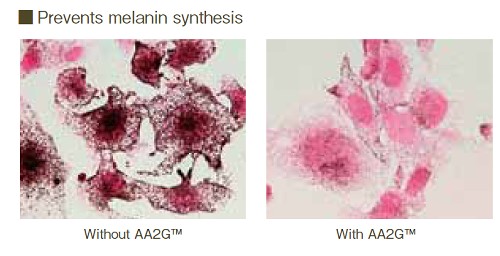
    Suppression of melanin synthesis:

    When Ascorbyl Glucoside is converted to vitamin C and enters the cells it significantly reduces the production of melanin by inhibiting tyrosinase activity. This results in a reduction of Dopaquinone, an intermediate of melanin synthesis. Additionally it converts existing Dopaquinone to L-Dopa.


    Ascorbyl Glucoside bleaching of extant melanin:

    When Ascorbyl Glucoside is converted to vitamin C and enters the cells it can significantly lighten existing black melanin by a reduction reaction.


    Reduction in  hyperpigmentation via AA2G topical application:
    Creams containing Ascorbyl Glucoside are beneficial for lightening skin pigmentation.

    Sixteen female volunteers (37 to 55 years old) applied a face cream containing 2% of AA2G™ twice a day to a hyperpigmented area of their face for a total of 90 days.The areas were matched against pantone color samples and the brightness (L* value) of the areas were measured by a colorimeter on day 0, 45 and 90. (*Significantly different from day 0 at <0.01)


     Ascorbyl Glucoside suppresses cellular damage due to UV irradiation:
    When Ascorbyl Glucoside is converted to vitamin C it can dramatically reduce the free radicals that result from UV irradiation of the skin, and significantly reduce cell damage. Human skin fibroblasts were cultured for 1 day. Fibroblast samples were cultured a second day with or without 1mM AA2G™. The cells were irradiated with 20mJ/cm2 UVA and B radiation, and then cultured for 2 additional days.
    The number of viable cells were determined. (*Significantly different from UV irradiated cells without AA2G™ at <0.05)


    Ascorbyl Glucoside promotes collagen synthesis:

    Collagen  plays an important role in the structure and firmness of skin.  Ascorbyl Glucoside is converted to vitamin C and  promotes collagen synthesis of skin fibroblasts. Ascorbyl Glucoside maintains its effects for a sustained period of time, resulting in increasing benefits.


    After cultivation of normal human skin fibroblasts for 1 day, the cells were cultured in the presence of vitamin C  0.2mM) or AA2G™ (0.2mM) for 2-4 days. The percentage of collagen to total protein was determined. (*Significantly  different from control at p<0.05, and significantly different from vitamin C at  p<0.05).


    Ascorbyl Glucoside reduces wrinkles and roughness:
    Products containing Ascorbyl Glucoside are highly beneficial for improving wrinkles and roughness of skin. Sixteen female volunteers (37 to 55 years old) applied a face cream containing 2% of AA2G™ twice a day for a total of 90 days to the outer corners of their eyes and cheek area. Silicone replicas of the corner of the eyes and the other treated areas were taken on days 0, 45 and 90 and wrinkle depth and skin roughness were measured by profilometry. (*Significantly different from day 0 at p<0.01)